Table of Contents
- 1. The Impact of AI on Cybersecurity: How the Threat Landscape Is Changing
- 2. Key AI Threats Businesses Must Be Prepared For
- 3. Why AI Risk Management Is Now a Business Necessity
- 4. Threat Detection and Response in the Age of AI
- 5. AI-Driven Cybersecurity Strategies for Organizations
- 6. Cloud Security Services and AI Workloads: New Risks, New Controls
- 7. How to Protect Businesses from AI Cyber Threats
- 8. How to Choose the Right Cybersecurity Service
- 9. The Future of Cybersecurity with AI
- 10. Conclusion
- 11. FAQs
Artificial intelligence has moved from experimentation to everyday business reality. It is reshaping how organizations operate, innovate, and compete. At the same time, it is also reshaping cybersecurity threats in ways many businesses are not fully prepared for. Modern attackers no longer rely on basic tactics. Instead, they use AI to automate attacks, analyze behavior patterns, and strike with unprecedented precision, making today’s AI threats harder to predict and even harder to stop.
The impact of AI on cybersecurity is now visible across industries. AI-powered phishing campaigns feel personal and convincing. Voice cloning and deepfake threats in cybersecurity can impersonate executives within seconds. Intelligent malware adapts its behavior in real time, bypassing traditional security tools designed for static threats. For organizations operating in cloud environments, the risks multiply as data, applications, and AI workloads become increasingly interconnected.
In this rapidly evolving landscape, security can no longer be reactive. Businesses must adopt smarter approaches to AI risk management, advanced threat detection and response, and scalable cybersecurity services that evolve alongside attackers. This blog explores how AI is transforming cyber risks, what it means for businesses today, and how the right mix of cloud security services and AI-driven defenses can help organizations stay one step ahead in an increasingly automated threat world.
The Impact of AI on Cybersecurity: How the Threat Landscape Is Changing
Artificial intelligence is changing not just how attacks are executed, but how quickly and intelligently they evolve. Understanding these shifts is essential for businesses looking to address modern cybersecurity threats and strengthen their overall security posture.
- AI has dramatically increased the speed of cyberattacks: Artificial intelligence enables attackers to automate reconnaissance, vulnerability discovery, and exploit execution. What previously required extensive manual effort can now be completed in minutes, allowing cybersecurity threats to emerge and spread faster than traditional defenses can respond.
- Cyber threats are becoming more targeted and precise: AI allows attackers to analyze user behavior, communication patterns, and organizational data. This results in highly targeted AI threats that focus on specific employees, systems, or business functions, significantly increasing the likelihood of successful breaches.
- AI-driven attacks continuously adapt to security controls: Modern malware powered by machine learning can change its behavior in real time to bypass firewalls, endpoint protection, and intrusion detection systems. This adaptability reduces the effectiveness of static, signature-based security tools.
- The scale and volume of attacks have expanded: AI lowers the technical barrier for cybercriminals, enabling large-scale attacks with minimal resources. Automated attack frameworks allow thousands of systems to be targeted simultaneously, increasing overall business risk.
- Identity-based attacks are becoming more convincing: AI-powered phishing, voice cloning, and impersonation attacks use realistic language and tone to deceive employees. Deepfake threats in cybersecurity now pose serious risks to executive communications, financial approvals, and sensitive data access.
- Cloud environments are increasingly exposed: As organizations move AI workloads and critical data to the cloud, attackers use AI tools to quickly identify misconfigurations and unsecured APIs. Without robust cloud security services, cloud-based infrastructures become prime targets.
- Traditional security models struggle to keep pace: Reactive security approaches and rule-based systems cannot respond effectively to fast-moving AI-driven attacks. This gap highlights the need for intelligent, proactive security frameworks.
- Threat detection and response must evolve: Advanced threat detection and response capabilities that use behavioral analysis and real-time monitoring are essential. These systems help organizations detect anomalies early and reduce the impact of AI-enabled cyber incidents.
Key AI Threats Businesses Must Be Prepared For
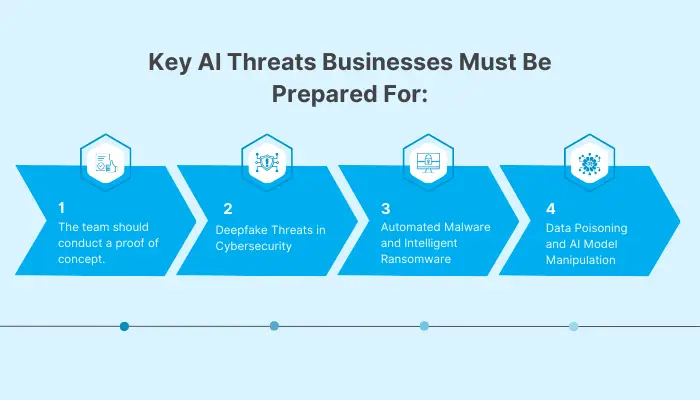
AI is not only strengthening cybersecurity defenses but also empowering attackers with smarter, faster, and more deceptive tools. Understanding these key AI-driven threats is critical for businesses looking to reduce risk and protect sensitive assets.
The following points highlight the most significant AI-driven threats that organizations must be prepared to identify and mitigate.
1. AI-Powered Phishing and Social Engineering:
The following points explain how AI has enhanced phishing and social engineering attacks, making them more targeted and difficult to detect.
- Highly personalized phishing campaigns: AI enables attackers to analyze publicly available data, email patterns, and communication styles to craft phishing messages that appear legitimate and context-aware, making them harder to identify.
- Automated large-scale phishing attacks: AI-driven tools allow cybercriminals to launch thousands of customized phishing emails simultaneously, increasing success rates while reducing manual effort.
- Exploitation of human trust and behavior: Social engineering attacks now leverage AI to mimic internal communications, vendors, or leadership, increasing the risk of credential theft and unauthorized access.
2. Deepfake Threats in Cybersecurity:
The following points outline the growing risks associated with deepfake-enabled attacks and their impact on organizational trust and security.
- Executive impersonation through voice and video cloning: AI-generated deepfakes can convincingly replicate the voices or faces of senior executives, enabling attackers to manipulate employees into authorizing payments or sharing confidential information.
- Financial fraud and reputational damage: Deepfake-based attacks can lead to direct financial losses and long-term damage to brand trust, especially when used in high-stakes decision-making scenarios.
- Erosion of digital trust: As deepfake technology becomes more accessible, verifying the authenticity of digital communications becomes increasingly difficult for organizations.
3. Automated Malware and Intelligent Ransomware:
The following points describe how AI-driven malware and ransomware have evolved to bypass traditional security controls:
- Self-adapting malware behavior: AI-powered malware can monitor system defenses and adjust its behavior to avoid detection, making traditional antivirus tools less effective.
- Faster lateral movement within networks: Intelligent ransomware uses AI to identify high-value systems and spread rapidly, maximizing operational disruption and potential ransom demands.
- Improved attack timing and execution: AI allows malware to remain dormant until optimal conditions are met, increasing the success rate of attacks.
4. Data Poisoning and AI Model Manipulation:
The following points highlight the risks of compromised AI training data and manipulated models on business operations:
- Corruption of training datasets: Attackers can inject malicious or misleading data into AI training datasets, causing models to produce inaccurate or biased outcomes.
- Manipulation of AI-driven business decisions: Compromised AI models can impact fraud detection, recommendation systems, and automated decision-making, leading to operational and financial risks.
- Long-term security and integrity risks: Data poisoning attacks are difficult to detect and can persist over time, undermining trust in AI systems and analytics.
Why AI Risk Management Is Now a Business Necessity
As AI becomes embedded in core business operations, unmanaged systems introduce significant security, operational, and compliance risks. The following points highlight why AI risk management is essential in today’s evolving threat landscape.
- Expands the attack surface: AI depends on data pipelines, APIs, and cloud infrastructure, increasing exposure.
- Introduces new attack vectors: AI models and training data can be directly targeted and manipulated.
- Amplifies the impact of cyber incidents: Compromised AI systems can automate and scale attacks rapidly.
- Protects data integrity: Strong controls help prevent data poisoning and model corruption.
- Reduces decision-making risks: Secure AI outputs ensure business decisions remain reliable.
- Improves threat detection and response: Risk management supports continuous monitoring and faster remediation.
- Supports regulatory and compliance requirements: Governance frameworks help meet data protection and AI security standards.
- Secures cloud-based AI workloads: Managed risks reduce vulnerabilities across distributed cloud environments.
- Limits operational disruption: Proactive controls help maintain system availability and performance.
- Builds long-term trust in AI systems: Well-managed AI enhances confidence among stakeholders and users.
Threat Detection and Response in the Age of AI
As cyberattacks become faster and more adaptive, traditional threat detection methods are no longer sufficient. AI-driven threats can change behavior in real time, evade signature-based tools, and exploit gaps before security teams can respond. This makes modern threat detection and response a critical pillar of cybersecurity strategies.
Secure Your Business Against AI Threats with AppSquadz!
Advanced cybersecurity and cloud security services built for today’s intelligent threat landscape.
Get Started
Advanced detection systems now rely on behavioral analytics, machine learning, and continuous monitoring to identify anomalies across networks, endpoints, and cloud environments. Instead of reacting after damage is done, organizations can detect suspicious activity early and respond automatically. AI-enabled response mechanisms help contain threats, isolate affected systems, and reduce the overall impact of security incidents, ensuring faster recovery and improved resilience.
AI-Driven Cybersecurity Strategies for Organizations
The following points provide an overview of the strategies that enterprises can use to defend against AI-based attacks:
- Adopting intelligent and adaptive security models: Organizations must move beyond static controls and implement AI-driven defenses that evolve alongside modern AI threats.
- Using AI for advanced threat analysis: AI analyzes large volumes of security data to identify patterns and signals that indicate emerging risks.
- Enabling predictive security measures: AI helps anticipate potential attacks and supports preventive action before threats escalate.
- Reducing false positives in security alerts: Machine learning improves detection accuracy, allowing security teams to focus on genuine threats.
- Automating security operations: AI-driven automation accelerates detection, investigation, and response processes.
- Integrating with managed cybersecurity services: When combined with managed services, AI-driven strategies provide scalable protection across complex and evolving IT environments.
Cloud Security Services and AI Workloads: New Risks, New Controls
As organizations move AI workloads to the cloud, security challenges expand alongside scalability and performance benefits. The following points highlight the key considerations for securing AI-driven cloud environments:
- AI workloads are increasingly hosted on cloud platforms, making cloud security services a critical part of modern cybersecurity strategies.
- Cloud environments introduce new risks such as misconfigurations, unsecured APIs, and potential data exposure.
- Continuous visibility across cloud infrastructure is essential for identifying suspicious activity early.
- Strong identity and access controls help prevent unauthorized access to AI systems and sensitive data.
- Encryption of data at rest and in transit protects AI workloads from data leaks and misuse.
- Cloud-native security tools enable monitoring and policy enforcement across distributed environments.
- AI-aware security controls help adapt defenses to evolving threats targeting cloud-based AI workloads.
- Integrated cloud security services reduce overall exposure while maintaining governance and compliance.
How to Protect Businesses from AI Cyber Threats
Protecting businesses from AI cyber threats requires a proactive and layered security approach that combines technology, processes, and people. The following measures help organizations reduce risk and strengthen their security posture.
- Secure identities and enforce strong access controls to limit unauthorized entry into systems and data.
- Implement Zero Trust principles to verify users and devices at every access point.
- Continuously monitor systems and networks to detect unusual or suspicious behavior early.
- Protect sensitive data through encryption and proper data classification practices.
- Strengthen endpoint and network security to reduce the impact of AI-driven attacks.
- Train employees to recognize AI-powered phishing and deepfake attacks that exploit human trust.
- Establish security awareness programs to reduce human error across the organization.
- Leverage advanced threat detection and response to identify and contain attacks quickly.
- Use managed cybersecurity services to maintain continuous protection and expert oversight.
How to Choose the Right Cybersecurity Service
Selecting the right cybersecurity service is critical in an AI-driven threat landscape. Businesses should look for providers that offer AI-enabled detection, real-time response, and scalable solutions that grow with organizational needs. Experience with cloud environments and AI workloads is particularly important for modern enterprises.
The right provider should also offer proactive monitoring, compliance support, and clear incident response processes. For many organizations, especially those with limited in-house expertise, managed cybersecurity services provide access to advanced protection without the complexity of managing security internally.
The Future of Cybersecurity with AI
The future of cybersecurity with AI will be defined by predictive, autonomous defense systems that can identify and respond to threats without human intervention. As attackers continue to use AI to enhance their capabilities, defenders will increasingly rely on AI to stay ahead.
Organizations that invest early in AI-driven security, strong governance, and continuous risk management will be better positioned to handle future threats. In this evolving landscape, cybersecurity will not just protect systems but will become a key enabler of innovation and business continuity.
Conclusion
Artificial intelligence has permanently changed the cybersecurity landscape. While AI enables innovation, automation, and scale, it also introduces faster, smarter, and more deceptive cyber threats that traditional security models can no longer handle alone. From AI-powered phishing and deepfake attacks to intelligent malware and cloud-based risks, businesses must now think beyond reactive security and adopt proactive, adaptive defenses.
Addressing these challenges requires a combination of AI risk management, advanced threat detection and response, cloud security services, and strong human awareness. Organizations that take a layered and forward-looking approach are better positioned to protect sensitive data, maintain operational continuity, and build long-term digital trust.
At AppSquadz, we help businesses navigate this evolving threat landscape with scalable cybersecurity services designed for modern AI-driven environments. By combining intelligent security technologies, cloud expertise, and proactive monitoring, AppSquadz enables organizations to stay resilient against emerging AI cyber threats. As AI continues to evolve, partnering with the right security provider like AppSquadz can make the difference between reacting to threats and staying ahead of them.
FAQs
1. How does AI increase cybersecurity threats?
Ans: AI enables attackers to automate attacks, analyze large datasets, and adapt tactics in real time. This makes cyber threats faster, more targeted, and harder to detect compared to traditional attacks.
2. What are the most common AI-driven cyber threats today?
Ans: Common AI-driven threats include AI-powered phishing, deepfake-based impersonation, automated malware, intelligent ransomware, and data poisoning attacks targeting AI models.
3. Why is AI risk management important for businesses?
Ans: AI risk management helps organizations identify vulnerabilities in AI systems, protect data integrity, meet compliance requirements, and reduce the operational impact of AI-driven cyber incidents.
4. How do cloud security services help protect AI workloads?
Ans: Cloud security services provide continuous monitoring, access control, encryption, and policy enforcement, helping secure AI workloads running across distributed cloud environments.
5. Can small businesses protect themselves from AI cyber threats?
Ans: Yes. With the right managed cybersecurity services, small businesses can access advanced threat detection, response capabilities, and cloud security without heavy infrastructure investment.