Table of Contents
- 1. What Is AWS Kiro?
- 2. Why AWS Kiro Matters for Modern Cloud Environments
- 3. Key Capabilities of AWS Kiro
- 4. AWS Kiro vs Manual DevOps
- 5. Why AWS Kiro Adoption Requires Training
- 6. Understanding the AWS Kiro Training Program
- 7. AWS Kiro Training by Role and Use Case
- 8. Benefits of AWS Kiro Hands-On Training
- 9. Future Scope of AWS Kiro and Enterprise Automation
- 10. How AppSquadz Helps Professionals and Enterprises with AWS Kiro Training
- 11. Conclusion
- 12. FAQ’s
In the race to deliver software faster and more reliably, speed is no longer just a competitive advantage; it has become a fundamental requirement for business continuity and growth. However, for many IT teams and enterprises, this urgency is challenged by the growing complexity of cloud infrastructure. Manual configurations, inconsistent environments, and fragile deployment pipelines create operational bottlenecks that slow innovation and increase risk. As cloud adoption scales, organizations need structured automation and standardized workflows to maintain stability without compromising delivery speed.
This is where AWS Kiro Training plays a vital role for enterprises and IT professionals. Through a comprehensive AWS Kiro Training Program, teams gain practical exposure to cloud automation, CI/CD pipelines, and infrastructure automation aligned with modern DevOps practices. AWS Kiro Training for DevOps and AWS Kiro corporate training enable organizations to build automation-first cloud environments while improving deployment consistency and operational efficiency. With rising demand for AWS Kiro corporate training in India, enterprises are increasingly adopting AWS Kiro hands-on training and workshops to equip their teams with scalable, future-ready cloud skills.
What Is AWS Kiro?
AWS Kiro is a cloud automation and DevOps enablement platform designed to help organizations standardize infrastructure management, automate CI/CD workflows, and reduce operational complexity across cloud environments. It enables teams to define, deploy, and manage cloud resources using repeatable, policy-driven automation rather than manual processes.
By integrating infrastructure automation with application delivery workflows, AWS Kiro helps enterprises maintain consistency, reliability, and governance as their cloud environments scale. It supports automation across development, testing, and production environments, making it easier for teams to manage change without increasing operational risk.
For enterprises adopting automation-first cloud strategies, AWS Kiro acts as a foundational layer that connects DevOps practices, infrastructure automation, and operational governance into a unified workflow.
Why AWS Kiro Matters for Modern Cloud Environments
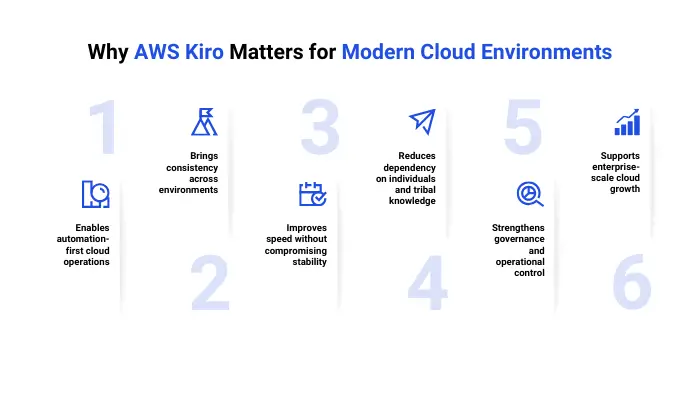
Key reasons AWS Kiro plays a critical role in modern cloud environments include:
- Enables automation-first cloud operations
AWS Kiro helps organizations replace manual and repetitive tasks with automated workflows. This reduces human error, improves efficiency, and allows teams to manage complex cloud environments more reliably as they scale. - Brings consistency across environments
By standardizing infrastructure provisioning and deployment processes, AWS Kiro ensures that development, testing, and production environments remain consistent. This minimizes configuration drift and avoids issues caused by environment mismatches. - Improves speed without compromising stability
AWS Kiro allows teams to accelerate application delivery through automated CI/CD workflows while maintaining control and reliability. Faster releases are achieved without introducing instability or operational risk. - Reduces dependency on individuals and tribal knowledge
Automation and standardized workflows reduce reliance on specific team members or undocumented processes. This improves continuity, simplifies onboarding, and strengthens operational resilience. - Strengthens governance and operational control
AWS Kiro supports policy-driven automation, helping enterprises enforce security, compliance, and operational standards consistently across cloud resources. - Supports enterprise-scale cloud growth
As cloud environments expand, AWS Kiro enables organizations to manage infrastructure and deployments efficiently without increasing operational overhead or complexity.
Key Capabilities of AWS Kiro
AWS Kiro provides a set of capabilities designed to simplify cloud automation and strengthen DevOps practices across enterprise environments.
Some of them are:
- CI/CD workflow automation: Enables teams to standardize and automate build, test, and deployment pipelines, reducing manual intervention and deployment errors.
- Infrastructure provisioning and automation: Automates the creation and management of cloud infrastructure, ensuring environments are deployed consistently and efficiently.
- Environment consistency across stages: Maintains uniform configurations across development, testing, and production environments, minimizing configuration drift.
- Governance and policy-driven automation: Supports automated enforcement of security, compliance, and operational policies across cloud resources.
- Scalability and operational reliability: Designed to support enterprise-scale cloud environments without adding complexity or operational burden.
AWS Kiro vs Manual DevOps
As cloud environments grow, the differences between automated and manual DevOps approaches become increasingly clear. The major differences are:
| Category | Manual DevOps | AWS Kiro |
| Infrastructure Provisioning | Manual setup and configuration | Automated and repeatable provisioning |
| CI/CD Pipelines | Script-heavy and inconsistent | Standardized, automated pipelines |
| Environment Consistency | High risk of configuration drift | Consistent across all environments |
| Deployment Speed | Slower and error-prone | Faster and more reliable |
| Governance and Compliance | Manual checks and audits | Policy-driven automated enforcement |
| Scalability | Difficult to manage at scale | Built for enterprise-scale operations |
| Operational Risk | High dependency on individuals | Reduced risk through automation |
| Change Management | Reactive and manual | Controlled and automated workflows |
Why AWS Kiro Adoption Requires Training
While AWS Kiro provides powerful automation capabilities, adopting it effectively requires the right skills and understanding. Many organizations underestimate the learning curve involved in designing automation workflows, integrating CI/CD pipelines, and aligning automation with governance and security requirements.
Without structured training, teams often struggle with inconsistent implementations, partial automation, or misuse of the platform. This can limit the value AWS Kiro delivers and introduce new operational risks. AWS Kiro Training ensures that teams understand not just how the platform works, but how to apply it correctly within real enterprise cloud environments. Through hands-on, role-aligned training, organizations can accelerate adoption, reduce errors, and ensure AWS Kiro supports long-term cloud scalability and reliability.
Understanding the AWS Kiro Training Program
The AWS Kiro Training Program is designed to help IT professionals and enterprises adopt a structured, automation-driven approach to cloud and DevOps operations. Rather than focusing only on theoretical concepts, the program emphasizes practical implementation of cloud automation, CI/CD workflows, and infrastructure management using AWS Kiro. This approach ensures learners can directly apply their skills to real-world enterprise environments.
A core strength of AWS Kiro Training lies in its hands-on learning model. Participants work with real scenarios that reflect modern enterprise challenges, including infrastructure automation, deployment standardization, and operational scalability. The program is suitable for both individual professionals and organizations seeking AWS Kiro training for enterprises, as it aligns technical learning with business outcomes. By completing the training, teams gain the ability to streamline cloud operations, reduce manual effort, and build consistent, repeatable workflows that support long-term growth and reliability.
AWS Kiro Training by Role and Use Case
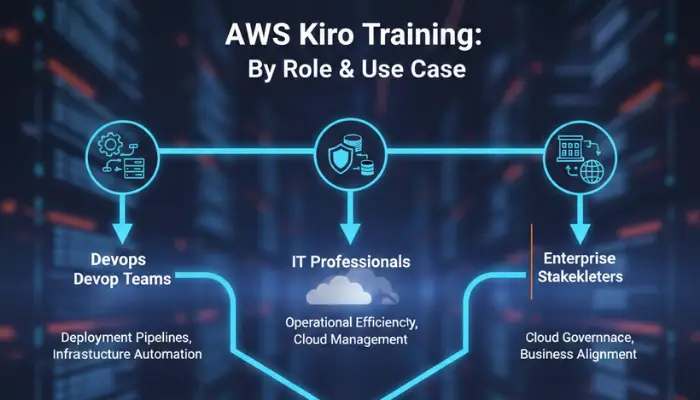
Modern cloud environments demand skills that align closely with specific roles and real business use cases. A one-size-fits-all training approach often fails to address the practical challenges faced by DevOps teams, IT professionals, and enterprise stakeholders. Kiro is designed to bridge this gap by tailoring learning outcomes to how cloud automation and DevOps practices are actually applied within organizations.
By structuring AWS Kiro Training around distinct roles and operational scenarios, organizations can ensure that each team gains relevant, hands-on expertise. Whether the focus is improving deployment pipelines, automating infrastructure, or enabling enterprise-scale cloud governance, this approach helps teams apply AWS Kiro capabilities directly to their responsibilities. As a result, businesses benefit from faster adoption, improved operational efficiency, and training outcomes that translate into measurable performance improvements across the cloud lifecycle.
To make this approach more practical, AWS Kiro Training is structured around the specific needs of key roles within an organization. Each training path focuses on real operational challenges, ensuring the learning is directly applicable to everyday cloud and DevOps workflows.
AWS Kiro Training for DevOps:
DevOps teams are under constant pressure to deliver faster releases while maintaining reliability across complex cloud environments. Manual deployments and fragmented pipelines often slow down delivery and increase operational risk. AWS Kiro Training for DevOps helps teams adopt automation-driven workflows that improve consistency and accelerate release cycles.
Here are some of the key ways AWS Kiro Training supports modern DevOps teams:
- Enables DevOps teams to automate CI/CD pipelines for faster and more reliable releases.
- Reduces manual deployment errors through standardized workflows.
- Supports infrastructure automation to manage environments at scale.
- Helps improve release velocity while maintaining stability and security.
- Ideal for teams adopting continuous delivery and automation-first DevOps practices.
AWS Kiro for Cloud Automation and Infrastructure Automation:
As cloud environments expand, managing infrastructure manually becomes increasingly inefficient and error-prone. Organizations need scalable automation to maintain consistency, governance, and performance across environments. AWS Kiro cloud automation training focuses on simplifying infrastructure management through repeatable and policy-driven automation.
AppSquadz AWS Kiro Training for Enterprise DevOps Automation
AppSquadz delivers hands-on AWS Kiro corporate training to standardize DevOps, CI/CD, and cloud automation at scale.
Get Started
Here are the core automation capabilities covered under AWS Kiro cloud automation and infrastructure automation:
- Automates infrastructure provisioning and configuration management.
- Ensures consistency across development, testing, and production environments.
- Enforces governance and compliance through automated workflows.
- Reduces operational overhead and dependency on manual processes.
- Supports scalable cloud operations aligned with enterprise growth.
AWS Kiro Corporate Training for Enterprises:
Enterprises operating large-scale cloud environments require training programs that align technical skills with business objectives. Disconnected learning often leads to inconsistent practices across teams. AWS Kiro corporate training for enterprises provides a structured and standardized approach to building cloud and DevOps capabilities across the organization.
Here are the primary benefits of AWS Kiro corporate training for enterprises:
- Upskills enterprise teams with role-aligned cloud and DevOps capabilities.
- Offers customizable training aligned with organizational workflows.
- Standardizes DevOps and cloud practices across departments.
- Reduces deployment risks and improves operational efficiency.
- Supports long-term cloud transformation initiatives.
AWS Kiro Workshop for Enterprises:
For organizations looking to accelerate adoption, workshops offer a focused and outcome-driven learning experience. AWS Kiro workshops for enterprises are designed to deliver hands-on exposure in a short time frame, helping teams apply concepts immediately. These workshops emphasize real-world enterprise challenges and practical implementation.
Here are the outcomes organizations can expect from AWS Kiro workshops for enterprises:
- Delivers immersive, real-world enterprise use cases.
- Ideal for rapid enablement and skill adoption.
- Covers CI/CD automation, infrastructure automation, and cloud optimization.
- Enables teams to solve practical challenges during the workshop.
- Produces actionable outcomes that can be implemented immediately.
AWS Kiro Training for IT Professionals:
IT professionals play a critical role in ensuring the stability and performance of cloud environments. As cloud operations become more automation-driven, traditional manual approaches are no longer sufficient. AWS Kiro training for IT professionals helps individuals build modern cloud automation skills that align with evolving enterprise requirements.
Here are the skills and capabilities IT professionals gain through AWS Kiro training:
- Supports the transition from manual operations to cloud automation.
- Builds practical skills in managing and optimizing cloud infrastructure.
- Improves day-to-day operational efficiency and system reliability.
- Enhances career-readiness for cloud and DevOps-focused roles.
- Suitable for system administrators, cloud engineers, and support teams.
Benefits of AWS Kiro Hands-On Training
Hands-on learning plays a critical role in building practical cloud automation and DevOps capabilities. AWS Kiro hands-on training focuses on real-world implementation, allowing teams to apply concepts directly within controlled environments. This approach improves skill adoption, reduces operational risk, and ensures training outcomes translate into real business value.
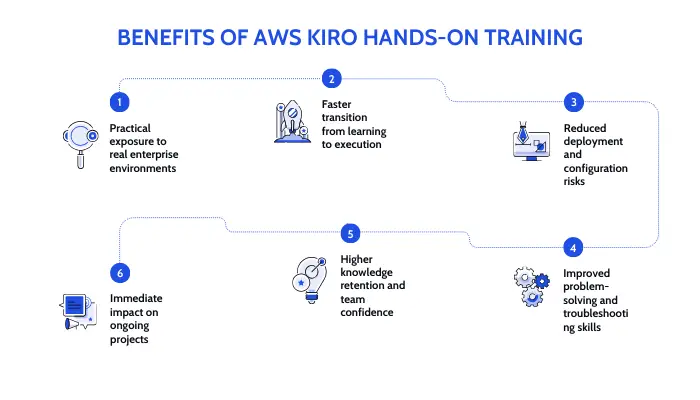
Benefits of joining the Kiro training:
- Practical exposure to real enterprise environments: Participants work on scenarios that reflect real production challenges, including CI/CD workflows, infrastructure automation, and cloud resource management. This helps teams understand how AWS Kiro is applied in day-to-day operations rather than learning concepts in isolation.
- Faster transition from learning to execution: Hands-on labs enable learners to practice automation tasks immediately, shortening the gap between training and on-the-job application. Teams can confidently implement workflows without long ramp-up periods.
- Reduced deployment and configuration risks: By testing automation and infrastructure changes in training environments, teams can identify issues early. This minimizes errors when applying AWS Kiro practices in live enterprise cloud systems.
- Improved problem-solving and troubleshooting skills: Real-time exercises expose learners to common automation failures and configuration challenges. This strengthens their ability to diagnose issues and optimize cloud workflows effectively.
- Higher knowledge retention and team confidence: Practical learning reinforces understanding and improves long-term retention. Teams gain confidence in using AWS Kiro tools, leading to better decision-making in production environments.
- Immediate impact on ongoing projects: Skills gained through AWS Kiro hands-on training can be applied directly to active DevOps and cloud initiatives, resulting in faster delivery, improved efficiency, and measurable operational improvements.
Future Scope of AWS Kiro and Enterprise Automation
As cloud adoption continues to grow, enterprises are increasingly prioritizing automation to manage complexity, reduce risk, and improve operational efficiency. AWS Kiro is expected to play a significant role in shaping how organizations design, deploy, and manage automated cloud environments in the coming years.
The following trends highlight how AWS Kiro will impact the future of enterprise automation:
- Shift toward automation-first cloud operations: Enterprises will continue to replace manual processes with automated workflows for provisioning, configuration, and deployment, making tools like AWS Kiro essential for maintaining consistency and reliability at scale.
- Deeper integration with DevOps and CI/CD practices: AWS Kiro is likely to become more tightly embedded within DevOps pipelines, enabling seamless coordination between application delivery and infrastructure automation across environments.
- Expansion of enterprise-scale infrastructure automation: As cloud environments grow in size and complexity, AWS Kiro will help organizations manage infrastructure more efficiently without increasing operational overhead or resource sprawl.
- Greater focus on governance, compliance, and security automation: Enterprises will increasingly rely on automated policy enforcement to meet regulatory and security requirements, positioning AWS Kiro as a key component of compliant cloud operations.
- Rising demand for AWS Kiro expertise and training: With broader enterprise adoption, professionals skilled in AWS Kiro automation will be in higher demand, driving the need for structured training programs and corporate upskilling initiatives.
- Long-term impact on business agility and innovation: By reducing operational bottlenecks and manual effort, AWS Kiro enables teams to focus on innovation, improve time-to-market, and respond more quickly to changing business needs.
How AppSquadz Helps Professionals and Enterprises with AWS Kiro Training
AppSquadz plays a strategic role in enabling professionals and enterprises to successfully adopt AWS Kiro through structured, outcome-driven training programs. Instead of generic, tool-focused learning, AppSquadz designs AWS Kiro Training programs that align cloud automation capabilities with real enterprise workflows, DevOps objectives, and business priorities. This ensures participants gain not only platform knowledge but also the practical confidence required to apply AWS Kiro effectively in production-grade cloud environments.
As an experienced cloud and DevOps partner working closely with Amazon Web Services, AppSquadz emphasizes hands-on, real-world enablement. Training is delivered through practical labs, real CI/CD pipeline scenarios, and infrastructure automation use cases that reflect actual enterprise challenges. Learners work with deployment standardization, environment consistency, and automation workflows that mirror live production systems, helping reduce the gap between learning and execution.
AppSquadz further strengthens AWS Kiro adoption by tailoring training programs to enterprise cloud maturity levels and team roles. AWS Kiro corporate training is customized to fit existing architectures, governance models, and operational workflows, enabling smooth integration without disruption. For professionals, this approach builds job-ready DevOps and cloud automation skills, while enterprises benefit from faster adoption, reduced operational risk, standardized practices, and improved delivery efficiency across cloud environments.
Conclusion
As enterprises continue to scale their cloud environments, the ability to automate infrastructure, streamline CI/CD pipelines, and standardize DevOps practices has become essential for long-term success. AWS Kiro Training enables organizations to move away from manual, fragmented processes and adopt an automation-first approach that improves reliability, speed, and operational efficiency. From DevOps teams and IT professionals to large enterprise environments, AWS Kiro equips teams with practical skills that translate directly into real-world outcomes.
With a strong focus on hands-on learning and enterprise use cases, AppSquadz helps organizations maximize the value of AWS Kiro Training through structured programs, workshops, and corporate training initiatives. By aligning technical training with business goals, AppSquadz ensures teams are prepared to manage complex cloud environments and support future growth. As demand for cloud automation skills continues to rise, partnering with AppSquadz allows enterprises to build future-ready teams and stay competitive in an increasingly automation-driven cloud landscape.
FAQ’s
1. What is AWS Kiro Training?
Ans: AWS Kiro Training is a structured learning program that helps professionals and enterprises develop skills in cloud automation, CI/CD workflows, and infrastructure automation using AWS Kiro. It focuses on practical, real-world implementation rather than only theoretical concepts.
2. Who should enroll in AWS Kiro Training?
Ans: AWS Kiro Training is suitable for DevOps engineers, IT professionals, cloud engineers, and enterprise teams responsible for managing and automating cloud environments. It is also valuable for organizations looking to standardize cloud and DevOps practices across teams.
3. Is AWS Kiro Training suitable for enterprises?
Ans: Yes, AWS Kiro corporate training is designed specifically for enterprises. It can be customized to align with organizational workflows, cloud maturity levels, and business objectives, making it ideal for large-scale cloud operations.
4. Does AWS Kiro Training include hands-on learning?
Ans: AWS Kiro Training includes hands-on training sessions that allow participants to work on real-world scenarios. This helps teams apply automation concepts directly to enterprise cloud environments and gain practical experience.
5. What are the career benefits of AWS Kiro Training?
Ans: AWS Kiro Training helps professionals build in-demand skills in cloud automation and DevOps. These skills improve job readiness, support career growth, and increase opportunities in organizations adopting automation-first cloud strategies.